Real-Time
Pathological Inference
A fully live, on-device neuro-ophthalmologic diagnostic suite transforming standard laptops into clinical-grade biometric and spatial triaging environments.
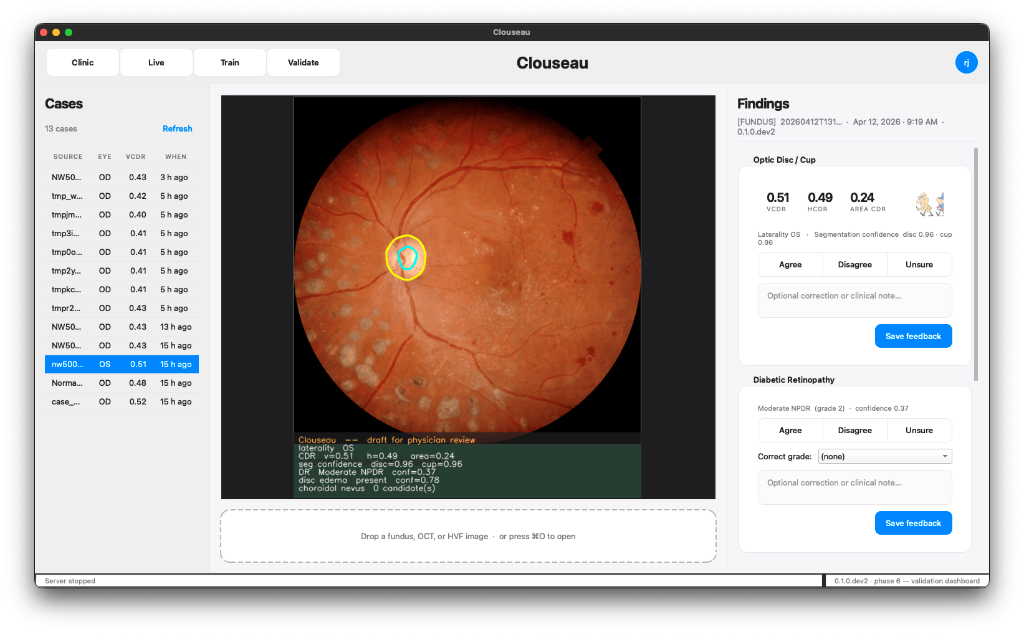
Zero Latency.
Complete Perimeter Security.
Forget the friction of uploading confidential patient data to slow, third-party web portals. Clouseau allows a physician to simply point their clinic's iPhone at a patient or hold up a raw printed diagnostic, and receive instantaneous clinical triaging on the device itself—drastically accelerating exam workflows while maintaining strict, localized HIPAA isolation.
Beyond standard structural CDR calculations, the fundus network is engineered to handle complex diagnostic arrays: running batch severity grades for Diabetic Retinopathy, identifying Choroidal Nevi, and mapping the critical edge-case impressions that distinguish true Papilledema from Pseudopapilledema.
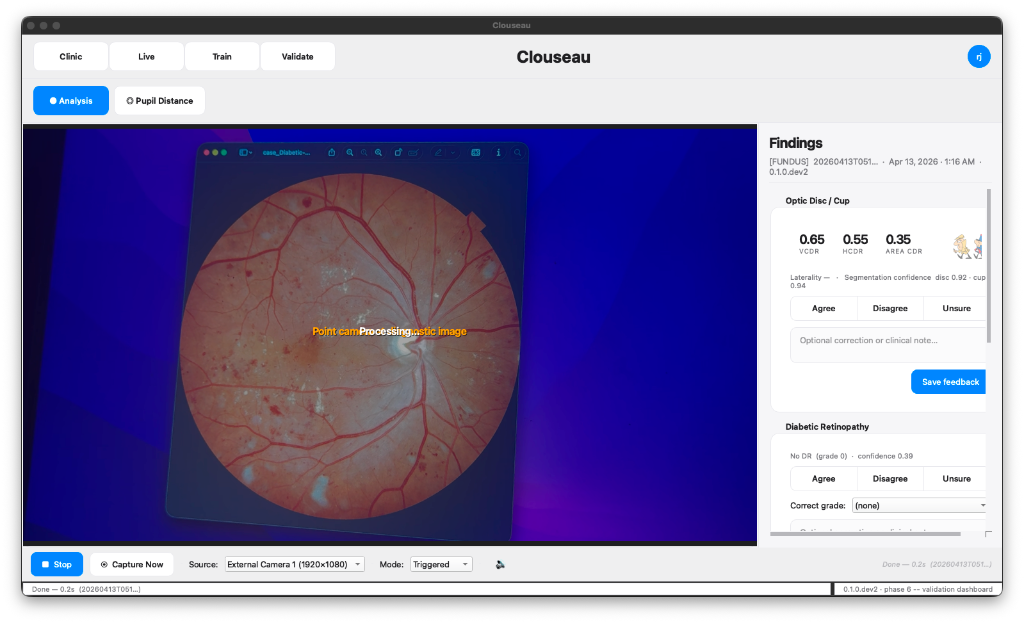
The Iris Biological Constant.
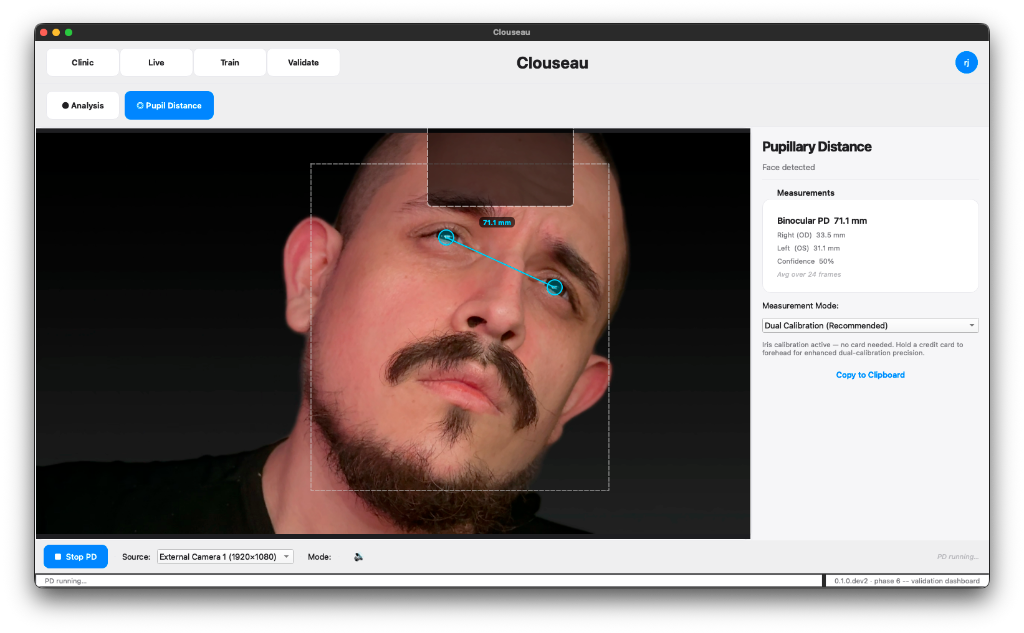
The Pupillary Distance suite represents a massive showcase of the live engine. To circumvent the need for deep-field hardware sensors, the platform utilizes the Iris Dual-Calibration system. By extracting the biological constant of the 11.7mm1 human iris, precise facial geometry and inter-pupillary data is deduced entirely through software.
This translates the diagnostic utility into an immediate revenue driver for the configuration and retail sale of bespoke eyewear.
The 6-Phase Master Blueprint
1. Foundations & GUI
Establish PySide6 router, Clinic interface, local case logging, and base application shell structures.
2. Computer Vision (Live)
Multi-camera routing, live contour detection, perspective warping, and optical flow stability thresholding.
3. Biometric Retail Engine
Build the Pupillary Distance suite. Overcome LiDAR blocks via the biological constant (Iris Dual-Calibration).
4. Foundational Pathologies
Integrate models tracking the Cup-to-Disc Ratio (CDR) across 3 parameters and mapping strict Optic Disc Edema.
5. Advanced Diagnostics
Train localized detectors for Diabetic Retinopathy arrays, Nevus identification markers, and Hemorrhage blooms.
6. Packaging & Profiling
Deep MPS profiling locking 30fps minimal CPU overhead alongside native macOS standalone .app packaging flows.
Beyond The Hardware
TrueDepth LiDAR Integration
Submitting the software biometric deductions to an eventual hardware-native iOS LiDAR bridge, generating absolute sub-millimeter spatial meshes for flawless optical configurations.
Isolated Local Host Networking
Transitioning into a dedicated iOS Phone Application that securely tunnels directly into the Local Clinic Network (LAN) to bypass HIPAA cloud-transmission friction entirely.
Multi-Modal Triage & In-RAM Inference
Expanding the ingestion engine to seamlessly interpret OCT, OCTA, and Humphrey Visual Field (HVF) outputs alongside dense 90-page MRI/discharge records. All complex processing is executed entirely within volatile RAM, or distributed securely across Apple device endpoints on the local network, without ever mounting sensitive PHI to disk.
Clinical References & Literature
-
The 11.7mm Iris Biological Constant: Accurate derivation of a patient's Horizontal Visible Iris Diameter (HVID) is a foundational metric in clinical optometry, particularly for determining the sagittal depth and best-fit parameters for soft contact lenses. Clinical consensus establishes the mean adult HVID anchor point at 11.7mm, allowing Clouseau's software to independently deduce absolute facial geometry without LiDAR.
Further reading: GSLS Poster — Optimizing Lens Fitting & the Importance of HVID